Yes, an EF-1 tornado can absolutely damage your roof. With winds of 86 to 110 mph, an EF-1 lifts and tears shingles, breaks the seal strips that keep water out, peels off ridge caps, and throws debris hard enough to puncture the roof deck. The damage is usually surface level instead of a roof torn clean off, which is EF-2 territory, but it is more than enough to start a leak that hides for months. After any tornado near San Antonio, get the roof checked even if it looks fine from the driveway, and document everything for your insurance claim. At BH Roofing the 27-point storm inspection is free, with photos and a written report.
Yes. An EF-1 tornado is more than capable of damaging your roof, and it does it more often than people expect. EF-1 is the second rung on the tornado scale, so it gets treated like the small one. It isn’t small to a roof.
An EF-1 packs winds of 86 to 110 mph. That range matters, because a lot of the asphalt shingles on San Antonio homes are rated below the top of it. So even a tornado that the news calls “weak” can be pulling harder than the roof was ever built to hold. The damage usually isn’t dramatic. It’s a few lifted shingles, a broken seal here and there, a dented vent. The quiet kind that turns into a ceiling stain in March.
Here’s what’s actually happening up there, what to look for after the storm, and how the insurance side works, with honest San Antonio numbers and no scare tactics.
How strong is an EF-1 tornado, and why does that matter for your roof?
An EF-1 produces winds between 86 and 110 mph. On the Enhanced Fujita Scale, the National Weather Service still files EF-0 and EF-1 under “weak,” which is where the underestimating starts. Weak is relative. Your roof doesn’t care what the meteorologist labeled it.
The reason those winds do damage is uplift. Wind moving over and around your roof drops the pressure above the shingles while the pressure inside the attic stays put. That difference tries to peel the roof up and off, and it pulls hardest at the edges, the corners, and the ridge. Tornado wind also rotates instead of blowing in one clean line, so it hunts for any loose edge from several directions at once. A roof that would shrug off a straight 90 mph gust can still lose shingles to a spinning 90 mph one.
Age stacks the deck too. Older San Antonio homes were built to older codes, with fewer fasteners and shingles that have spent a decade baking brittle in the heat. Brittle shingles crack instead of flexing. That’s a big part of why a borderline EF-1 can rough up one house and barely touch the newer one next door.
Will my shingles survive an EF-1 tornado?
Depends on what’s on your roof. This is where the wind rating actually means something, so here are the real numbers.
| Roof covering | Rated wind resistance | EF-1 (86 to 110 mph)? |
|---|---|---|
| 3-tab asphalt shingles | 60 to 70 mph | Usually fails |
| Architectural (laminate) shingles | 110 to 130 mph | Usually holds |
| Class 4 impact-resistant shingles | 110 to 130 mph, plus impact rated | Best odds, also resists the hail |
| Standing seam metal | 110 to 160+ mph | Holds in most EF-1s |
Read that top row again. Plain 3-tab shingles, the cheap ones builders used on a lot of older San Antonio neighborhoods, are rated to fail somewhere around 60 to 70 mph. An EF-1 starts at 86. So a 3-tab roof can be losing shingles before the storm is even at the middle of the EF-1 range. Architectural shingles, which is what most newer homes have, are rated to about 110 to 130 mph and usually ride out an EF-1 with only minor losses.
Here’s a worked example. Say you’ve got a 15-year-old 3-tab roof and an EF-1 comes through at 95 mph. The shingles are rated for maybe 65, they’re brittle from years of sun, and the wind is rotating. It’s not a question of whether you lose some shingles. It’s how many, and whether the seal strips on the rest got broken in the process, because broken seals leak even when the shingle is still lying flat.
What kind of roof damage does an EF-1 tornado actually cause?
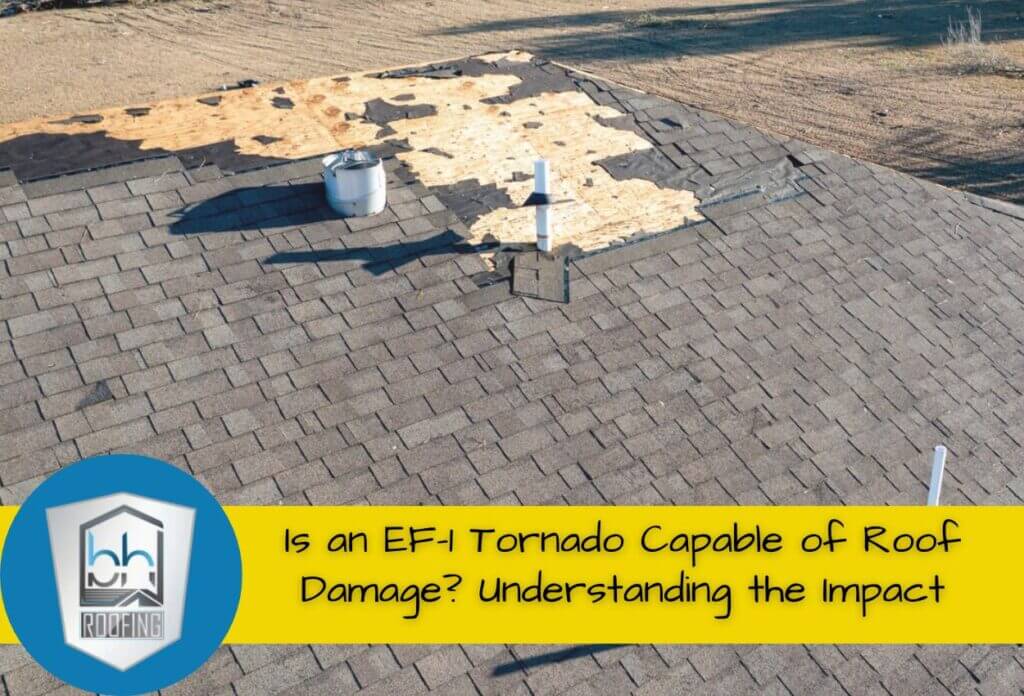
Shingle damage first, almost every time. The wind lifts, curls, and tears shingles off, and it starts at the ridge caps and the edges where the leverage is greatest. Lose the ridge caps and the spine of the roof is open. Even the shingles that stay put can have their seal strips snapped, and that’s the sneaky one. The shingle looks fine from the ground while water has a clear path underneath it.
Flying debris is the other big one. An EF-1 turns branches, a neighbor’s patio chair, and loose fence boards into things moving at highway speed. Those punch holes and bruise shingles, and a lot of those punctures sit on parts of the roof you can’t see from the yard. Hail usually rides along with these storms too, so you can end up with wind damage and impact damage on the same roof.
Then there’s everything the wind gets into once the surface is breached. Lifted flashing around the chimney and the vents. Water working into the decking, the insulation, and down into the ceilings. The roof damage is the start. The storm damage that follows it inside the house is what actually runs up the bill, and it does most of that quietly over the following weeks.
How do I check my roof for damage after a tornado?
Start on the ground, and stay there. Grab binoculars and walk the whole house. You’re looking for missing or crooked shingles, bare patches where the deck shows, bent flashing, and dents on vents or gutters. Check the gutters and the splash blocks for a pile of shingle granules, because heavy granule loss means the shingles took a beating even if they’re still up there.
Then go into the attic with a flashlight, ideally after the next rain. Wet insulation, dark stains on the rafters, or little pinpoints of daylight through the deck all mean the roof got opened up somewhere. Photograph everything you find, wide shots and close-ups both, before anybody touches it. Those photos are the backbone of an insurance claim.
What you should not do is climb up on the roof. A lot of it you shouldn’t try to read yourself anyway. A pro brings moisture meters and thermal imaging to find the wet spots and broken seals that are invisible to the naked eye, and a roof inspection done right catches the hidden stuff before it becomes a ceiling repair. Do the ground check yourself, then have a roofer confirm it. That combination is the whole move.
What should I do first after an EF-1 tornado damages my roof?
Stop the water, then document, then call. In that order.
If you can see a hole, missing shingles, or an open spot, get a heavy tarp over it to keep the next rain out. Hold the tarp down with boards laid across it, not nails driven through the deck, because every nail is a fresh hole you’ll have to fix later. If the damage is bigger than a tarp and a ladder can safely handle, that’s what emergency roof tarping crews are for, and around here we get out for that fast.
Before you make any temporary fix, photograph and video all of it. Wide shots of the whole roof, close-ups of each damaged spot, and a note of the date and rough time the storm hit. That record is what ties the damage to the storm when you file.
One safety line that isn’t optional: if you see a sagging roof section, cracked ceiling drywall, or anything that looks structural, stay out of those rooms and get a roofer out before you do anything else. Pull valuables out if you can do it safely. Simple as that.
Does homeowners insurance cover EF-1 tornado roof damage?
Usually, yes. Standard homeowners policies cover wind and hail, and a tornado is wind, so EF-1 roof damage is normally a covered claim. That’s the good news. The fine print is where people get tripped up.
Two things to check on your own policy. First, the clock. Most policies give you about a year to file, and some carriers run a tighter window than that, so the move is to file fast while the storm is clearly the cause. Second, the deductible. A lot of Texas policies carry a separate wind and hail deductible, and it’s often a percentage of your home’s insured value instead of a flat dollar amount, which can make it bigger than you’d guess. Read those two lines before you need them.
The thing that wins or loses these claims is documentation, and it’s the part you control. Dated photos, an inspection report, and a clear timeline make the difference between a clean approval and a fight. We handle insurance claim documentation all the time, so if you’re staring at a damaged roof and a claim form, that’s a normal day for us.
How do I make my roof more tornado-resistant?
You can’t tornado-proof a roof, but you can move the odds a long way in your favor, and most of it is worth doing in San Antonio regardless of tornadoes.
Hurricane straps are the big structural one. They’re metal connectors that tie the roof framing down to the walls and create a continuous path for the load, so the uplift has a much harder time peeling the roof up. If you’re curious how that works, we broke it down in our guide to hurricane straps. On the surface, Class 4 impact-resistant shingles are the upgrade that pays off twice, since they handle higher winds and shrug off the hail that rides in with these storms, and a lot of Texas insurers knock money off your premium for having them. Underneath, ring-shank nails and better-fastened decking give the wind less to grab.
None of it is exotic. It’s mostly choices you make at the next reroof, which is the cheapest time to make them. If your roof is already near the end of its life, building the next one to take the wind is the smart play.
Get a free 27-point storm inspection from BH Roofing
An EF-1 doesn’t have to tear your roof off to cost you. A few broken seals and a couple of lifted shingles are enough to leak you into a five-figure repair, and they’re nearly invisible from the ground. That’s the whole reason to get up there and look after a storm.
At BH Roofing we do a free 27-point inspection on storm-hit roofs, with thermal imaging for the hidden wet spots, photos of everything, and an honest written report instead of a sales pitch. Our team handles everything from a few replacement shingles to a full re-roof, and we deal with the insurance side every week.
If an EF-1 just came through and you think your roof took a hit, call BH Roofing at (210) 267-9029. Storm damage is an emergency, and we respond within 24 hours.