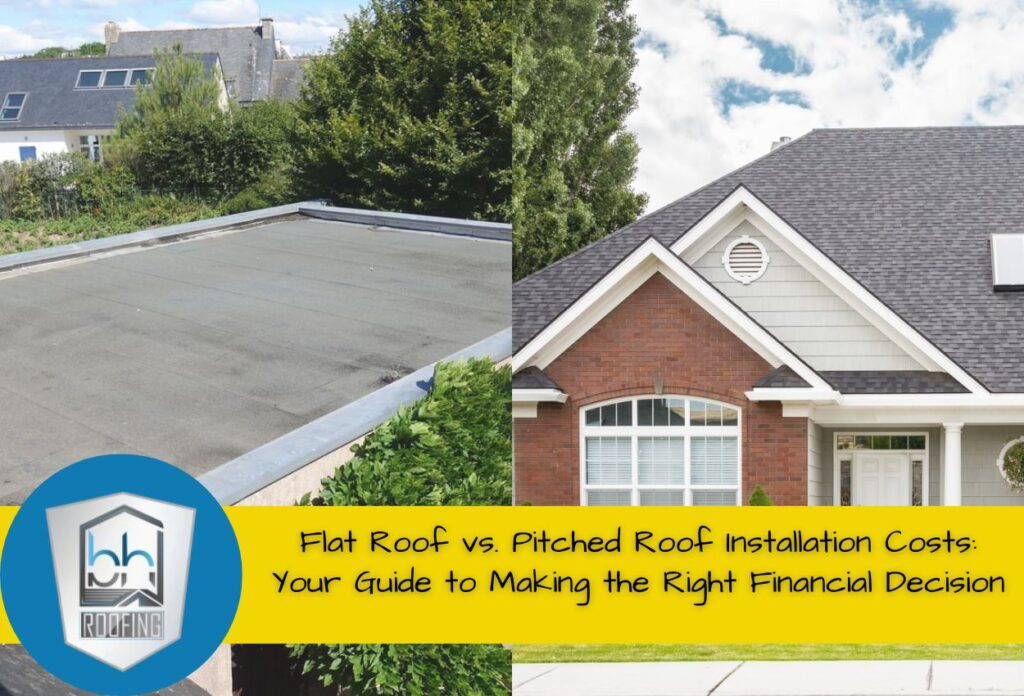
For the same home, a flat roof usually costs less to install than a pitched roof, roughly $4 to $10 per square foot versus $5 to $12, which works out to about 15 percent cheaper up front. But the comparison has a twist: a pitched roof covers more surface area than a flat one over the same floor plan, and it lasts a lot longer, often 20 to 50-plus years versus 15 to 30 for a flat membrane. So the flat roof tends to win the install bill while the pitched roof usually wins the long-term cost. In San Antonio most homes are pitched asphalt shingle, with flat and low-slope systems common on modern homes and additions. At BH Roofing we install both and give honest numbers for your specific roof, and the assessment is free.
If you’re weighing a flat roof against a pitched one, the honest short answer is that a flat roof almost always costs less to install, and a pitched roof almost always costs less to own. Flat runs roughly $4 to $10 a square foot installed versus $5 to $12 for pitched, so the upfront bill is lower. But pitched roofs last longer and shed water better, which is where they earn the money back.
That tradeoff is the whole decision, so it’s worth seeing the real numbers side by side before you assume the cheaper sticker price is the cheaper roof. Here’s how the costs actually break down, why per-square-foot pricing is a little misleading, and which one makes sense for a San Antonio home.
Is a flat roof or a pitched roof cheaper to install?
A flat roof is usually cheaper up front, by around 15 percent for a comparable home. The membrane goes down fast, there’s less material than a steep roof, and the labor is simpler than working on an angle. A pitched roof costs more per square foot to install because of the slope, the underlayment and flashing layers, and the added safety and time that steep work demands.
Here’s where the common materials land, installed.
| System | Material | Installed cost (per sq ft) | Typical lifespan |
|---|---|---|---|
| Flat | EPDM rubber | $4 to $8 | 10 to 25 yrs |
| Flat | TPO or PVC | $5 to $10 | 20 to 30 yrs |
| Flat | Modified bitumen | $4 to $8 | 15 to 20 yrs |
| Pitched | Asphalt shingle | $5 to $9 | 20 to 30 yrs |
| Pitched | Metal | $10 to $16 | 40 to 70 yrs |
| Pitched | Tile or slate | $12 to $25+ | 50+ yrs |
A flat membrane roof on a typical house tends to land somewhere between about $6,800 and $13,000. A pitched asphalt roof on the same house often costs a bit more, and metal or tile pushes well past it. But the sticker price is only half the story.
Why is the cost comparison more complicated than per-square-foot?
Two things make the flat-is-cheaper headline misleading. First, surface area. A pitched roof has more square footage than a flat roof covering the same floor plan, because the slope stretches the surface. So even though pitched material costs less per square foot in some cases, you’re buying more square feet of it. The gap between the two narrows once you account for that.
Second, and bigger, is lifespan. A flat membrane typically lasts 15 to 30 years depending on the material, while a pitched roof commonly runs 20 to 50-plus. Spread the cost across the years you actually get, and the pitched roof often comes out cheaper per year of service even though it cost more on day one. That’s why the right way to compare them is total cost of ownership, not the install quote alone.
How long does each roof last?
Pitched wins longevity, usually by a wide margin. On the flat side, EPDM rubber runs about 10 to 25 years, TPO and PVC membranes 20 to 30, and modified bitumen 15 to 20. On the pitched side, asphalt shingles last 20 to 30 years in our heat, metal 40 to 70, and tile or slate can pass 50.
Maintenance follows the same pattern. Flat roofs need more regular attention, since water sits on them instead of running off, so seams, drains, and low spots have to be watched. A pitched roof sheds water by design, which means fewer maintenance visits and more localized repairs when something does go wrong. Neither is maintenance-free, but the flat roof asks for more of it.
What drives the price up on each one?
On a flat roof, the hidden costs cluster around water. Because the surface is nearly level, it needs a real drainage plan, which means tapered insulation to build slope, properly placed drains, and overflow protection. Skimp on that and you get ponding water, which is the number one killer of flat roofs. Structural reinforcement and fire or wind-uplift code requirements can add to the bill too.
On a pitched roof, complexity is the cost driver. A simple gable is cheap to shingle. Add dormers, valleys, multiple slopes, and steep pitches and the labor climbs fast, because every intersection needs custom flashing and cutting, and steeper work needs more safety setup. On either roof, a tear-off of the old material, decking repairs, and ventilation upgrades are the surprises that show up once work starts, which is why an honest quote starts with an inspection.
Which roof is better for a San Antonio home?
For most San Antonio houses, a pitched asphalt roof is the default, and for good reason: it sheds our heavy downpours, handles hail better, lasts longer, and fits the look of most neighborhoods. Flat and low-slope roofs show up on modern-style homes, additions, and over porches and carports, where the architecture calls for it.
If you do go flat here, the two things that matter most are a reflective surface and real drainage. A white flat roof membrane reflects our brutal sun instead of soaking it up, and proper slope keeps water moving toward the drains instead of pooling. Ponding is the issue we see most on San Antonio flat roofs, and we wrote a separate guide on fixing flat-roof ponding because it’s so common. For a standard pitched home, a quality architectural shingle is usually the best balance of cost and life. Either way, the right call depends on your specific house, not a rule of thumb.
Get an honest flat or pitched roof quote from BH Roofing
The cheapest roof to install and the cheapest roof to own are often two different roofs, and the only way to know which is right for your home is to price your actual roof, not a national average. That’s what a real assessment is for.
BH Roofing installs both flat and pitched roofs across San Antonio, from TPO and modified bitumen membranes to architectural shingle, metal, and tile. Our team looks at your roof, your slope, and your plans for the home, then gives you honest numbers for each option and tells you which one actually pencils out, with no pressure either way.
Call BH Roofing at (210) 267-9029 for a free roof installation or replacement quote, and find out what your roof really costs before you decide.